What Does a Short Read on a Multimeter
Are you confused by all the symbols on a multimeter? Are you wondering what that piddling line with a squiggle next to it could perhaps mean? Perhaps you're still learning how to use your multimeter or maybe you've had yours for a while, but are merely unsure on what a couple of the symbols actually hateful because you've never had to use that setting. This guide is for you. We're going to explain in item what settings and symbols mean on the common meter.
The last thing you want when troubleshooting an important issue with your digital multimeter is to misunderstand what the reading means. This could exist especially dangerous if you were trying to undertake a continuity exam and accidentally had your instrument set to the Volt measurement.
In our guide we're using the Fluke 117, we chose the Fluke because they're a keen all round multimeter and they have the symbols and settings that you'll discover on 95% of the multimeters on the market. Take annotation of the yellowish symbols around the dial, these readings can only be performed after pressing the SHIFT button. The SHIFT push works the same equally on a standard keyboard, you just printing it and the meter will perform and additional part, depending on where you take set the punch.
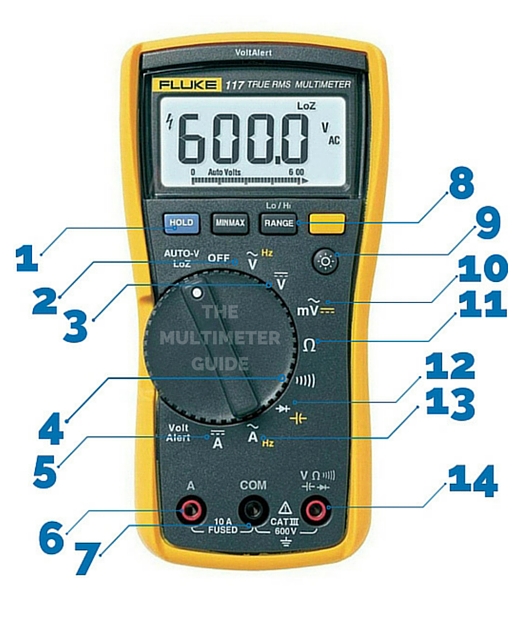
Number 1: Hold Button. This button will "concord" whatever the meter reads after you have pressed information technology. This is a bully feature if you demand to remember the exact reading of what you're measuring or if yous cannot see the multimeter whilst you lot're testing with the test lead or probes
Number ii: AC Voltage. This will be your nigh common setting for testing voltages around the home or work. Depending on where you lot live, you will typically measure betwixt 100-240 volts Air-conditioning.
SHIFT: Hertz. Used to measure the frequency of your excursion or equipment. Dissimilar equipment and circuits are designed to operate at either fixed or variable frequency, then it's important you know that before you undertake your test.
Number 3: DC Voltage. The DC Voltage setting will enable you to test small electronic ciruits, indicator lights and batteries. 99% of the time you come up beyond DC Voltage, it will exist below 30 volts DC.
Number 4: Continuity. The meter will emit an audible tone when continuity is detected between two points. This is a fast and effective way for finding short circuits, or open circuits. Simply place one probe on one point, and another probe on another signal and and your meter will give yous a visual and audible signal.
Number 5: Direct Current. The same every bit Alternating Electric current (Number 13), but with Directly.
Number 6: Current Jack. Simply to exist used for measuring current amps with either a cherry-red test lead, or a dedicated clamp attachment. If you use a defended clamp meter, you will most likely not have this jack on your unit.
Number 7: Common Jack. Used for all tests and is only to be used with the black examination atomic number 82.
Number eight: Range Push. Used to bicycle betwixt different ranges of your meter. Most meters have auto-ranging, only some have the selection of selecting a specific range. For case, yous may desire to know what your Ohms reading is in mega-ohms.
Number ix: Brightness Button. Cycles the backlight of the display from dim, to bright.
Number 10: Air conditioning Millivolts. If y'all're testing a small ciruit on the AC Voltage setting and the reading is low, information technology's brash that yous switch to the Air conditioning Millivolts setting to obtain a more accurate reading.
SHIFT: DC Millivolts. As higher up, only with DC voltage.
Number 11: Ohms. This setting is used to mensurate the resistance, which is measured in ohms. The function on its own is called an ohmmeter. A neat style to check the accuracy of your multi meter is to get a resistor that you know the resistance of, and use the ohms setting to test the resistance. If it reads correctly, yous can be sure that your DMM is accurate. The ohm setting also a quick and piece of cake mode to test the condition of fuses - if the meter reads OL, the you can be sure the fuse has blown. SAFETY Notation: simply test fuses with the ohms setting when they are OUT of the circuit.
Number 12: Diode Examination. The diode examination setting is the most reliable way to test if your diodes are good or bad. The other style to exam if a diode is functioning as it should involves using the Ohms setting, however it isn't as authentic as using a dedicated diode test.
SHIFT: Capacitance. It is extremely important to notation that some capacitors volition have an electric charged stored in them, even later on power has been turned off. Please ensure you safely belch capacitors before measuring their capacitance.
Number xiii: Alternating Electric current. Normally performed with the improver of a clamp attachment, the alternating current test is a must for tests such as how much load an apparatus is drawing.
Number fourteen: Cherry Jack. Used for all tests likewise current, including: voltage, resistance, frequency, diode, duty bike, temperature, impedance and capacitance.
Nosotros hope that you have found this guide useful. Having fifty-fifty a basic electrical cognition and your own testers will help y'all greatly, and could save you lot thousands of dollars in electrician costs. In maxim that, voltage and current can be extremely dangerous - even at small measurements, exist sure to call an electrician if you have any doubts and never deport out any work that requires yous to be licensed.
Source: https://www.themultimeterguide.com/multimeter-symbols-guide/
0 Response to "What Does a Short Read on a Multimeter"
Postar um comentário