Clinical Application of Continuity Dream Hypothesis
Introduction: Continuity and Non-Continuity
Cognition may be defined as the mental action or process of acquiring knowledge and understanding through thought, experience, and the senses. The question addressed in this article is how cognition is the same and how it changes when we are dreaming and how this change may be helpful to the dreamer when awake.
When we dream, there is both continuity and non-continuity between the dream-self and the wake-self. There is continuity of the dream and wake-self's emotional reactions to events, people, and behavior. While implausible dream events often go unquestioned, the dreamer's emotional reaction to these events within the context of the dream is similar to wake-life reactions. This similarity suggests that the core person, asleep or awake, reacts similarly.
Non-continuity is in the occurrence of unlikely or impossible dream events and behaviors where people and places that span different times and different ages may be weaved together as if they were occurring in the moment.
Non-continuity provides the dream-self with new situations, such as when the dream-self interacts with her 5-year-old son, who in wake life is 15 years old, or when the dream-self interacts with a deceased parent. Continuity is because one's emotionaol reaction to the son or parent is similar to what they would have been in wake life even though the experience cannot occur when awake. Our wake and dream reactions remain tethered despite unlikely behaviors or logical inconsistencies in the dream.
The most common non-continuity between the dream and wake-self is in a character's behavior, Kahn and Hobson (2003). An example of non-continuity of behavior between the dream and wake-self might be if the dream-self is having sex with someone he or she would not in wake life. Does the dream-self feel guilty? How does the dream-self react? How to not get caught? Even if the behavior of the dream-self is unlikely to happen in wake-life, the emotional reactions of the wake-self would be the same as that of the dream-self, feeling guilty, how to not get caught, etc.
Having both, continuity and non-continuity between our dream and wake lives, helps explain both the cognitive connection and the disconnection between our dream and wake worlds.
Continuity between our dream and wake worlds may also be said to occur if dreams simulate and prepare us for social engagement when awake as in the theory of Revonsuo et al. (2016) and Tuominen et al. (2019). Continuity can also help with emotional well-being, Pesant and Zadra (2006), Cartwright (2010), Walker and van der Helm (2009), Walker (2017). Another example of continuity between the wake and dream worlds is the retaining of a theory of mind while dreaming, i.e., knowing what our dream characters are thinking, Kahn and Hobson (2005b).
Previous studies that have examined different kinds of non-continuity include those of Horton (2017) who has argued that non-continuity in dreaming has a functional role in the process of memory consolidation by separating memories from their original contextual role. They are taken out of their original context and are newly integrated with existing memories "rendering salient aspects of those memories to become available for retrieval in isolation from their contextual features."
Another benefit of non-continuity between the dream and wake-self is the making of unexpected associations and in the number and kind of associations that become linked during dreaming, e.g., see Horton and Malinowski (2015), Cai et al. (2009), Kahn and Gover (2010), Wagner et al. (2004), Stickgold et al. (1999). In the Stickgold et al. (1999) study, non-continuity between wake and dream sleep was explored through the use of a semantic priming task that measured the reaction time to find a word when it is preceded by a word that is associated with it. The study found that semantic priming was state dependent in that subjects awakened from REM sleep showed greater priming by weak primes than by strong ones during the REM carryover period. Subjects tested during normal wake hours showed greater priming by strong primes, as expected.
These unexpected and enhanced associations have been shown to enhance creativity in the wake state since creative problem solving improved if sleep contained REM, Cai et al. (2009). Subjects who had achieved REM sleep during a nap did better on a remote association task (RAT) than those who only had NREM or had no nap at all. These authors found that "REM enhances the integration of unassociated information for creative problem solving" (Cai et al., 2009).
Several other studies have demonstrated that after a night's sleep there is an enhanced ability to find a hidden rule or obtain an insight that helps solve a difficult problem. After waking from REM sleep subjects were often able to solve problems that were intractable during the day, Wagner et al. (2004), Walker and Stickgold (2004), Walker et al. (2002).
Previous studies that have examined different kinds of continuity between dream and wake experiences include those by Schredl and Hofmann (2003), Hobson and Schredl (2011), Schredl (2000, 2003, 2006), Horton (2017), Horton and Malinowski (2011), Malinowski et al. (2014), Malinowski and Horton (2011, 2015), Kahn and Hobson (2003, 2005a), Kahan and LaBerge (2011), Kahan et al. (1997), Domhoff (2011), Kozmová and Wolman (2006), Samson and De Koninck (1986), Sutton et al. (1994), Llewellyn (2011, 2013).
Dream Recall
Several of the above studies compared the ability to problem solve when awake with and without a previous nap or sleep containing REM. Several studies have also addressed the relevance of dream recall to enhanced problem solving after REM sleep, Blagrove (2007), Cartwright (2010), Schredl et al. (2003). Some of these have shown that dream recall, in fact, is relevant to problem solving. When we do recall dreams that have elements of a task previously learned, the dreams help improve performance on the previously learned task, Wamsley and Stickgold (2009, 2019). These authors showed that only when elements of the maze navigation task were incorporated in the dream did improvement occur after sleep.
Even if the dream is not recalled, the dream experience may still become a part of the general autobiographical and episodic memories that go into making up the core individual. The experience though not recalled into conscious awareness may become available on a non-conscious level as suggested in the study by Siclari et al. (2017). These authors found that high-frequency activity in prefrontal regions as occurs in dreaming "may mediate cognitive functions… such as encoding and storing long-term memories, … and planning and executing tasks." Further, according to Hobson (2009), whether dream recall happens or not, sleep and dreaming provide a protoconsciousness that is fundamental toward the eventual development of full consciousness.
Methodology
In this article, we have used the data from our original study on thinking (Kahn and Hobson, 2005a) to study the reactions of the dream-self to its own and to other dream characters' actions. In the original study, we did not rely on outside judges to determine what the dreamer was or was not thinking. We asked the dreamer to say whether thinking had occurred and if so what its characteristics were. The advantages and disadvantages of this protocol have been previously discussed (Kahn et al., 2002).
For this study, we reexamined the submitted dream reports in the original 2005a study for instances when not only thinking but also emotional reactions to dream events and people were reported in their comments on thinking. In the original study about thinking, emotional reactions to events and people were not explicitly excluded. In fact, comments of participants almost always mentioned their emotional reactions along with their thinking in their comments.
Sample Size
We first briefly review the sample and methodology of the original study. The sample consisted of 26 subjects, 24 young adults between the ages of 18 and 22 (15 women and 9 men attending a local college and not familiar with dream studies) and 2 older male adult subjects who are considered experts in dream studies.
The students submitted 151 dream reports over a 2-week period. The two older "dream expert" subjects submitted 27 dream reports over a 2-week period. The two population groups were combined since no substantial differences were found when the two population groups were considered individually.
The 26 participants submitted 178 dream reports in which there were 747 instances when thinking was reported to have occurred. Mean number of reports per subject was 6.8 (SD = 3.2). The mean number of words per report was 223 (SD = 112).
Upon awakening, participants in the study were asked to answer the question: would your thinking be the same as it was in the dream, if the event that occurred in the dream, occurred while awake? Please comment on how your thinking in the dream was the same or different than your thinking if awake.
Upon awakening, the participants were also asked to answer the question: "Would your thinking be the same regarding the occurrence of the event itself?"
Results of the Original and Current Study
The answers to these questions from the 26 subjects were analyzed with the aid of the statistical package "Statview 5.0." For each subject a mean value was calculated and from these an overall mean value. Most subjects replied that had their dream event occurred while awake, their thinking would have been the same as it was during the dream. The results are statistically significant. The majority of subjects also responded that their thinking about the occurrence of the event would not have been the same had they been awake. This difference was statistically significant to the p = 0.02 level. Thinking within the dream event was similar to waking but that thinking about the dream event was different. Subjects who said that their thinking within a dream event was the same as wake-state thinking, often went on to say that their thinking about the dream event was different than their wake state thinking. This combination was more than four times as common as its opposite; subjects rarely stated that their thinking within a dream event was different from their wake-state thinking and that their thinking about the dream event was the same as their wake-state thinking. All the above results were replicated when we calculated the two kinds of thinking on a per dream report basis as on the per dream event basis, reported above.
About 58.7% of the participants reported thinking within the context of the dream was the same, 32.9% reported thinking was different, and 6.4% could not decide. About 55.1% of the participants reported their thinking about dream context was different than it would have been had they been awake, 39.2% reported their thinking about dream context the same, and 3.5% could not decide.
The results from the original Kahn and Hobson, 2005a study are summarized below in Figures 1 and 2, further details may be found in the original.

Figure 1. Thinking within a dream event. Descriptive statistics for the number of responses that thinking during a dream event would have been the same even if awake (Y within event/event), that thinking would have been different (N within event/event), and cannot decide if it would have been the same or not (? within event/event). The difference between subjects' responses is highly significant based on a paired t test for significance between subjects' responses from Kahn and Hobson (2005a).

Figure 2. Thinking about a dream event. Descriptive statistics for the number of responses that thinking about the dream event would have been the same even if awake (Y about event/event), that thinking would have been different (N about event/event), and cannot decide if it would have been the same or not (? about event/event). The difference between subjects' responses is significant based on a paired student t test for significance between subjects' responses from Kahn and Hobson (2005a).
Methodology in the Current Study
For the present study, we looked at the comments of the participants to these questions. It was discovered that almost all comments included participants' emotional reactions not just their thinking.
Below are examples of participants' answers to questions on thinking within and about a dream event when their emotional reactions were reported. These reactions both within and about a dream event are presented in tabular form (Table 1) below.
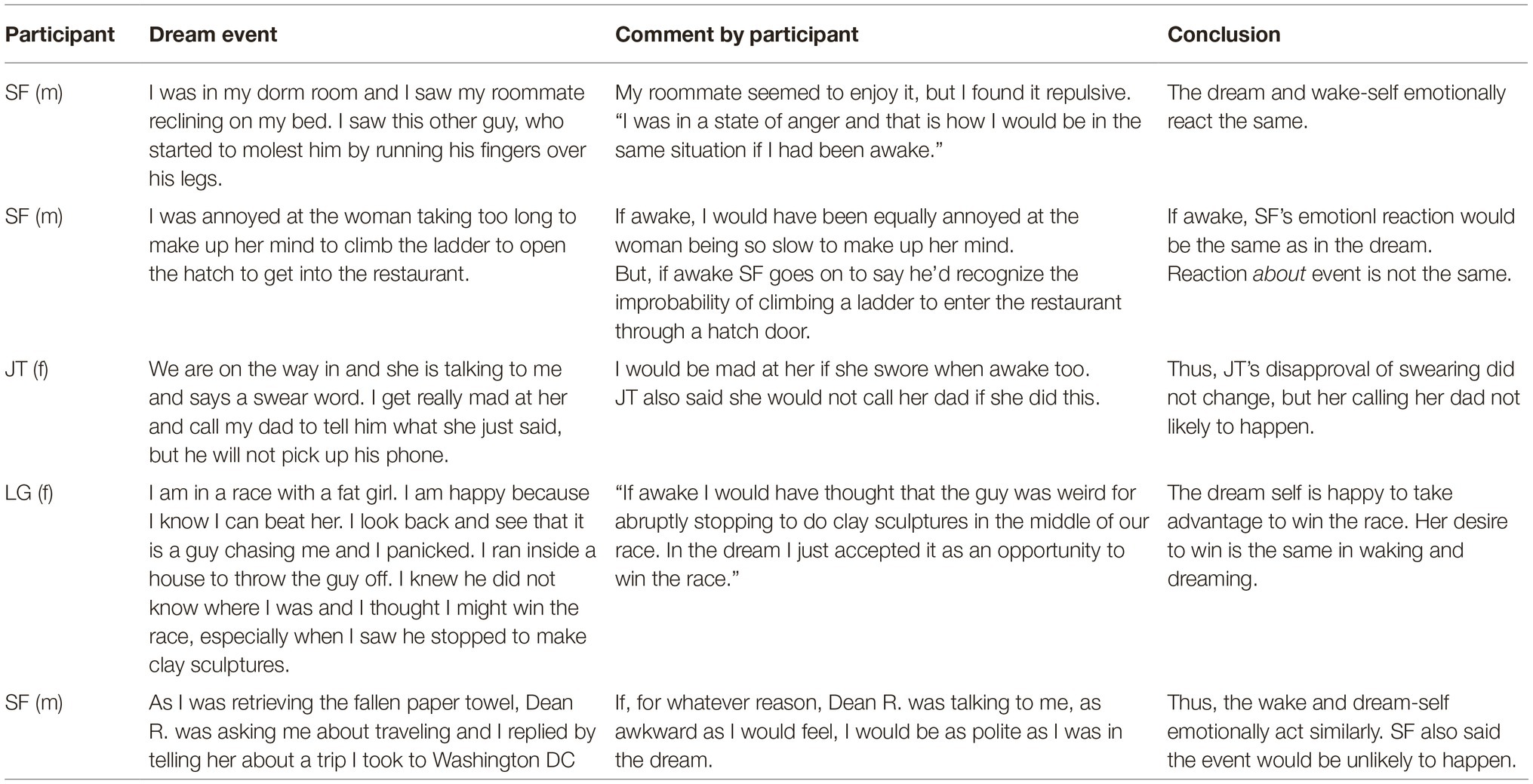
Table 1. Dream events, comments, and conclusions.
In essentially every case, when a comment was given, participants reported about how they reacted emotionally. They reported how they emotionally reacted within the context of the dream and how they emotionally reacted about the content of the dream in comparison to how they would have reacted if awake. This approach should be validated in a future study that directly asks participants about their emotional reactions to events and people in the dream.
Discussion
The Kahn and Hobson (2005a) study found that thinking by the dream-self within the context of the dream was similar to that of the wake-self. Thinking by the dream-self about dream content was different than that of the wake-self in that the dream-self did not question dream content as its wake-self would.
The current study found that emotional reactions of the dream-self were similar to how its wake-self would react. If the dream-self became impatient, angry, or happy about its own or a dream character's behavior, its wake-self would have reacted the same. In general, participants reported that their emotional reactions within the context of the dream were similar to what its wake-self's would have been. The study also found that reactions between the dream and wake-self were different about implausible dream content. Implausible content would have been noticed by its wake-self.
Thus, there is both continuity and non-continuity while dreaming. While the wake-self would not (or could not) engage in some of the behaviors of the dream-self, the result that emotional reactions of the dream-self and wake-self are similar shows that a continuity exists between the dream-self and the wake-self.
The non-continuity part is that the dream and wake-self's reactions to unlikely and improbable events are different. However, bizarre upon awakening, within the dream, events go unquestioned and are accepted as occurring in the here and now. This acceptance is one reason that our emotional reaction to events and people within the dream are not different than when awake. The result that there is continuity between the dream-self and wake-self in their emotional reactions to events suggests that emotional reactions are state-independent, occurring in both the dream and wake states.
Continuity, Non-continuity, Brain Changes, and Emergence
It is, in fact, remarkable that there is continuity between the dream and wake-self given how the brain's chemistry and neural activity have changed from waking to dreaming and the fact that the emergent dream is different than its individual source elements, Kahn (2013, 2016). Serotonin and norepinephrine are absent in rapid eye movement (REM) dreaming, and reduced in NREM dreaming. No longer is the brain presented with a balanced concentration of cholinergic and aminergic chemistry, and no longer is the neural activity of the executive portions of the prefrontal areas as active as in the wake state, Braun et al. (1997), Maquet (2000), Cicogna and Bosinelli (2001), Hobson et al. (2000), Nir and Tononi (2010), Siclari et al. (2017). This study suggests that despite the brain changes that give rise to non-continuity between dream and wake content, continuity between the dream and wake-self's emotional reactions within the context of the dream persists. This, in turn, suggests that core personality traits are state-independent.
Data Availability Statement
The datasets generated for this study are available on request to the corresponding author.
Author Contributions
The author confirms being the sole contributor of this work and has approved it for publication.
Conflict of Interest
The author declares that the research was conducted in the absence of any commercial or financial relationships that could be construed as a potential conflict of interest.
References
Blagrove, M. (2007). "Dreaming and personality" in The new science of dreaming: Volume 2. Content, recall, and personality correlates. eds. Barrett, D., and McNamara, P. (Westport, CT, US: Praeger Publishers/Greenwood Publishing Group), 115–158.
Google Scholar
Braun, A. R., Balkin, T. J., Wesenten, N. J., Carson, R. E., Varga, M., Baldwin, P., et al. (1997). Regional cerebral blood flow throughout the sleep-wake cycle. An H2(15)O PET study. Brain 120, 1173–1197. doi: 10.1093/brain/120.7.1173
PubMed Abstract | CrossRef Full Text | Google Scholar
Cai, D. J., Mednick, S. A., Harrison, E. M., Kanady, J. C., and Mednick, S. C. (2009). REM, not incubation improves creativity by priming. PNAS 106, 10130–10134. doi: 10.1073/pnas.0900271106
CrossRef Full Text | Google Scholar
Cartwright, R. D. (2010). The twenty-four hour mind: The role of sleep and dreaming in our emotional lives. New York: Oxford University Press.
Google Scholar
Domhoff, G. W. (2011). Dreams are embodied simulations that dramatize conceptions and concerns: the continuity hypothesis in empirical, theoretical, and historical context. Int. J. Dream Res. 4, 50–62. doi: 10.11588/ijodr.2011.2.9137
CrossRef Full Text | Google Scholar
Hobson, J. A., Pace-Schott, E. F., and Stickgold, R. (2000). Dreaming and the brain: towards a cognitive neuroscience of conscious states. Behav. Brain Sci. 23, 793–842. doi: 10.1017/S0140525X00003976
PubMed Abstract | CrossRef Full Text | Google Scholar
Hobson, J. A., and Schredl, M. (2011). The continuity and discontinuity between waking and dreaming: a dialogue between Michael Schredl and Alan Hobson concerning the adequacy and completeness of these notions. Int. J. Dream Res. 4, 3–7. doi: 10.11588/ijodr.2011.1.9087
CrossRef Full Text | Google Scholar
Horton, C. (2017). Consciousness across sleep and wake: discontinuity and continuity of memory experiences as a reflection of consolidation processes. Front. Psychol. 8:159. doi: 10.3389/fpsyt.2017.00159
CrossRef Full Text | Google Scholar
Horton, C. L., and Malinowski, J. E. (2011). Re-defining discontinuity: implications for the functions of dreaming. Int. J. Dream Res. 4, 78–80. doi: 10.11588/ijodr.2011.2.9147
CrossRef Full Text | Google Scholar
Horton, C. L., and Malinowski, J. E. (2015). Autobiographical memory and hyperassociativity in the dreaming brain: implications for memory consolidation in sleep. Front. Psychol. 6:874. doi: 10.3389/fpsyg.2015.00874
PubMed Abstract | CrossRef Full Text | Google Scholar
Kahan, T. L., LaBerge, S., Levitan, L., and Zimbardo, P. (1997). Similarities and differences between dreaming and waking cognition: an exploratory study. Conscious. Cogn. 6, 132–147. doi: 10.1006/ccog.1996.0274
PubMed Abstract | CrossRef Full Text | Google Scholar
Kahn, D. (2016). The dream as part of an emergent process. Emerg. Complex. Organ. 18, 1–5.
Google Scholar
Kahn, D., and Gover, T. (2010). Consciousness in dreams. Int. Rev. Neurobiol. 92, 181–195. doi: 10.1016/S0074-7742(10)92009-6
CrossRef Full Text | Google Scholar
Kahn, D., and Hobson, J. A. (2003). State dependence of character perception. J. Conscious. Stud. 10, 57–68.
Google Scholar
Kahn, D., and Hobson, J. A. (2005a). State-dependent thinking: a comparison of waking and dreaming thought. Conscious. Cogn. 14, 429–438. doi: 10.1016/j.concog.2004.10.005
CrossRef Full Text | Google Scholar
Kahn, D., and Hobson, J. A. (2005b). Theory of mind in dreaming: awareness of feelings and thoughts of others in dreams. Dreaming 15, 48–57. doi: 10.1037/1053-0797.15.1.48
CrossRef Full Text | Google Scholar
Kahn, D., Pace-Schott, E., and Hobson, J. A. (2002). Emotion and cognition: feeling and character identification in dreaming. Conscious. Cogn. 11, 34–50. doi: 10.1006/ccog.2001.0537
PubMed Abstract | CrossRef Full Text | Google Scholar
Llewellyn, S. (2013). Such stuff as dreams are made on? Elaborative encoding, the ancient art of memory, and the hippocampus. Behav. Brain Sci. 36, 589–607. doi: 10.1017/S0140525X12003135
PubMed Abstract | CrossRef Full Text | Google Scholar
Malinowski, J., Fylan, F., and Horton, C. L. (2014). Experiencing "continuity": a qualitative investigation of waking life in dreams. Dreaming 24, 161–175. doi: 10.1037/a0037305
CrossRef Full Text | Google Scholar
Malinowski, J. E., and Horton, C. L. (2011). Themes of continuity. Int. J. Dream Res. 4, 86–92. doi: 10.11588/ijodr.2011.2.9149
CrossRef Full Text | Google Scholar
Malinowski, J. E., and Horton, C. L. (2015). Metaphor and hyperassociativity: the imagination mechanisms behind emotional memory assimilation in sleep and dreams. Front. Psychol. 6:1132. doi: 10.3389/fpsyg.2015.01132
PubMed Abstract | CrossRef Full Text | Google Scholar
Pesant, N., and Zadra, A. (2006). Dream content and psychological well-being: a longitudinal study of the continuity hypothesis. J. Clin. Psychol. 62, 111–121. doi: 10.1002/jclp.20212
PubMed Abstract | CrossRef Full Text | Google Scholar
Revonsuo, A., Tuominen, J., and Valli, K. (2016). "The simulation theories of dreaming: how to make theoretical Progress in dream science" in Open MIND: Philosophy and the mind sciences in the 21st century. eds. Metzinger, T., and Windt, J. (Cambridge, MA: MIT Press), 1341–1348.
Google Scholar
Samson, H., and De Koninck, J. (1986). Continuity or compensation between waking and dreaming: an exploration using the Eysenck personality inventory. Psychol. Rep. 58, 871–874.
Google Scholar
Schredl, M. (2000). Continuity between waking life and dreaming: are all waking activities reflected equally often in dreams? Percept. Mot. Skills 90, 844–846. doi: 10.2466/pms.2000.90.3.844
CrossRef Full Text | Google Scholar
Schredl, M. (2003). Continuity between waking and dreaming: a proposal for a mathematical model. Sleep Hypn. 5, 26–40.
Google Scholar
Schredl, M. (2006). Factors affecting the continuity between waking and dreaming: emotional intensity and emotional tone of the waking-life event. Sleep Hypn. 8, 1–5.
Google Scholar
Schredl, M., Wittmann, L., Ciric, P., and Götz, S. (2003). Factors of home dream recall: a structural equation model. J. Sleep Res. 12, 133–141. doi: 10.1046/j.1365-2869.2003.00344.x
PubMed Abstract | CrossRef Full Text | Google Scholar
Siclari, F., Baird, B., Perogamvros, L., Bernardi, G., LaRocque, J. J., Riedner, B., et al. (2017). The neural correlates of dreaming. Nat. Neurosci. 20, 872–878. doi: 10.1038/nn.4545
PubMed Abstract | CrossRef Full Text | Google Scholar
Sutton, J. P., Rittenhouse, C. D., Pace-Schott, E., Stickgold, R., and Hobson, J. A. (1994). A new approach to dream bizarreness: graphing continuity and discontinuity of visual attention in narrative reports. Conscious. Cogn. 3, 61–88. doi: 10.1006/ccog.1994.1005
CrossRef Full Text | Google Scholar
Tuominen, J., Stenberg, T., Revonsuo, A., and Valli, K. (2019). Social contents in dreams: an empirical test of the social simulation theory. Conscious. Cogn. 69, 133–145. doi: 10.1016/j.concog.2019.01.017
PubMed Abstract | CrossRef Full Text | Google Scholar
Walker, M. (2017). Why we sleep: Unlocking the power of sleep and dreams. New York, United States: Simon and Schuster.
Google Scholar
Walker, M. P., Brakefield, T., Morgan, A., Hobson, J. A., and Stickgold, R. (2002). Practice with sleep makes perfect. Neuron 35, 205–211. doi: 10.1016/S0896-6273(02)00746-8
PubMed Abstract | CrossRef Full Text | Google Scholar
Wamsley, E. J., and Stickgold, R. (2009). "Incorporation of waking events into dreams" in The neuroscience of sleep. eds. Stickgold, R., and Walker, M. (London: Academic Press), 330–336.
Google Scholar
Wamsley, E. J., and Stickgold, R. (2019). Dreaming of a learning task is associated with enhanced memory consolidation: replication in an overnight sleep study. J. Sleep Res. 28:e12749. doi: 10.1111/jsr.12749
PubMed Abstract | CrossRef Full Text | Google Scholar
Source: https://www.frontiersin.org/articles/10.3389/fpsyg.2019.02676/full
0 Response to "Clinical Application of Continuity Dream Hypothesis"
Postar um comentário