At What Age Does a Baby Grow a Bond to Mom
We oft assume that giving birth triggers firsthand feelings of joy and unconditional dearest that last a lifetime. Just later on a long and painful delivery, not every parent feels immediately attracted to the wrinkled and crying newborn who desperately wants to get back into the womb. If this sounds shocking, it may be because a social stigma around "irksome bonding" makes people reluctant to share such experiences.
While many parents actually practice experience the birth of their baby as a major and happy life event, some have an immediate reaction of wishing it had never have happened. And a large proportion of parents will fall somewhere in between, perhaps having simultaneous feelings of wonder and feet or even frustration. Merely what is normal and what constitutes a problem? And what can you lot do to increase your chances of successful bonding?
Parent-infant bonding is frequently dislocated with infant-parent zipper. Bonding is the parental feeling of being continued with the infant, experiencing a sense of unconditional dear and closeness. Attachment, on the other hand, describes the infant'due south need to be shut to a protective caregiver. Both develop gradually during the first twelvemonth of life, based on a biological preparedness and the experience of frequent interactions.
False beliefs about bonding proliferate on social media and the cyberspace, ofttimes under the umbrella of "attachment parenting" – suggesting that, for example, early skin-to-peel contact is indispensable for bonding, or that breastfeeding and co-sleeping would be needed – or fifty-fifty the female gender.
Merely research on infants adopted at around 6 months later on birth demonstrates that bonding within the first few weeks or even months is non necessary for a secure zipper betwixt the baby and a female parent or father to sally. Nevertheless, pregnancy, delivery and breastfeeding might aid the man mind to gear up for the new parental responsibilities.
How mutual is slow bonding?
The fact that bonding is an ongoing process rather than a bolt of lightening that hits you in one case and for all tin perhaps explain the fact that people accept such different experiences. The number of parents who report not falling in love immediately with their newborn varies, but it tin can exist between 25% and 35% depending on definition and type of measure out.
But even if bonding can take fourth dimension, it ordinarily happens for all parents eventually. According to a contempo Scandinavian survey, at six months afterward nascence, only almost 4% of the mothers and 5.5% of the fathers showed "impaired bonding" ("irksome" is a better discussion).
So what helps parents bail? When women get pregnant, they experience huge hormonal changes. Their oxytocin levels increase during pregnancy, and summit effectually childbirth and when breastfeeding. A first effect of oxytocin is that it is relaxing and makes us forget painful experiences – which is rather welcome afterward giving birth.
Simply oxytocin also affects the salience of social signals, making parents more attentive to signs that the baby is happy or distressed. In our brain scanning studies, we gave women a nose spray with oxytocin to investigate its consequence further. We institute that women with college oxytocin levels had more connectivity between the brain'due south reward centres when they listened to infant laughter – suggesting they enjoyed it more than others.
At the same time, when listening to infant crying, oxytocin led these same women to accept less action in the amygdala, a encephalon region involved in anxiety, and more than activeness in empathy-related brain regions. Given that it takes just seconds after nascency before babies cry, and effectually six weeks before they grin, the hormonal organisation helps young parents to overcome the beginning tiring weeks.
Oxytocin may also assist distinguish between baby cries that need an firsthand response and crying that is not urgent, but instead marks the transition from being awake to being asleep in some babies. The brains of women who sniffed oxytocin as part of our written report showed less activity when we told them the cry came from a "bored baby" than when it came from a "sick baby". Such context data, colouring the pregnant of the very same cry sound, was better taken into business relationship when oxytocin levels were loftier.
Oxytocin also assist fathers. When we asked fathers to take a sniff of it they played in a more stimulating and sensitive fashion with their kid. And nosotros know that fathers' oxytocin levels increase in the first half-dozen months later on the baby'due south born, and go upwards during active play with their infants.
So experience helps, too. A new study has shown that the brains of parents respond differently to infant crying than the brains of non-parents – they process the sound in a more firsthand and emotional manner. This is in contrast with non-parents, who use more than cognitive processing. Moreover, one study in fathers showed that connections in the encephalon that support caregiving increase with the number of hours they are directly responsible for infant care.
Bonding support
A lack of bonding is strongly associated with experiencing exhaustion, burn-out, sleepless nights and postnatal depression. These are things that tin mess with our brain chemistry.
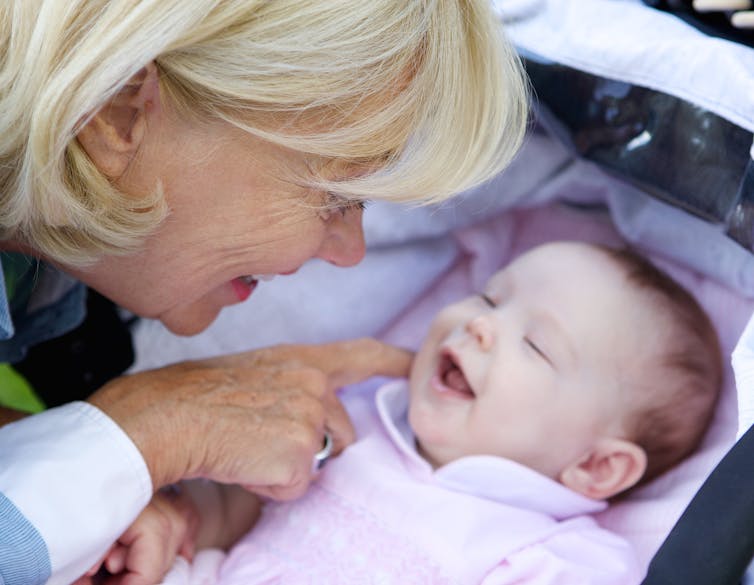
Raising and successfully bonding with newborns therefore requires all parents to share the workload. Mothers are in fact evolved to rely on the support of others to enhance their offspring, and children have evolved to become fastened to more than one caregiver for survival in a unsafe world.
That means in that location's no reason to assume that babies tin't become attached to fathers just every bit easily equally they can be attached to mothers. It is also an argument for societies to facilitate (slow) bonding of both mothers and fathers through paid parental go out. The bulk of countries, withal, neglect to provide paid paternity exit.
At that place are also tricks to speed the process up. For instance, many parents do good from watching videos of pleasurable experiences derived from moments of shine interplay with their baby. Babe carriers might too be helpful to sooth a crying baby, and to strengthen parental bonding.
Ultimately, the birth of a baby is a major life event and bonding helps parents cope. Just it is a process and tin can accept time. A lack of initial bonding doens't mean you have failed – the vast bulk of parents successfully bail with their baby after the first few months, after they become to know her. And for anyone struggling at this point, talk to a wellness professional about getting back up.
With time, practice and support to learn the new linguistic communication of the baby, bonding is likely to develop – slowly simply definitely.
Source: https://theconversation.com/bonding-with-baby-what-it-should-feel-like-and-how-long-it-may-take-133280
0 Response to "At What Age Does a Baby Grow a Bond to Mom"
Postar um comentário